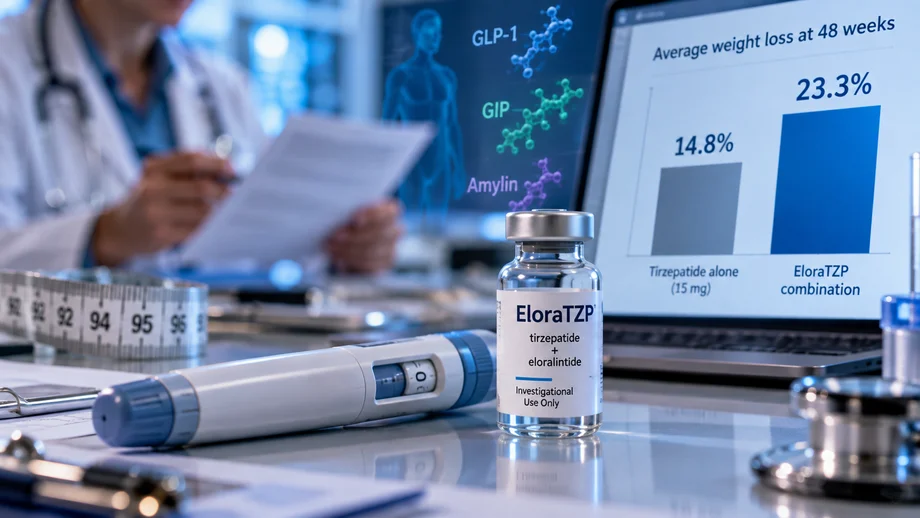
A new experimental obesity treatment from Eli Lilly has produced significantly greater weight loss than the company's blockbuster drug Zepbound in a direct clinical trial comparison.
The treatment, known as EloraTZP, combines tirzepatide, the active ingredient in Zepbound and Mounjaro, with an experimental drug called eloralintide.
Results released Wednesday, September 30, showed that participants receiving the highest tested dose of the combination lost an average of 23.3% of their body weight after 48 weeks.
Participants receiving the highest dose of tirzepatide alone lost an average of 14.8%.
The findings come from a Phase 2b clinical trial involving 367 adults with obesity or overweight and type 2 diabetes in the United States and Argentina.
The results are potentially significant because people with type 2 diabetes typically experience less weight loss from obesity medications than people without diabetes.
However, EloraTZP remains experimental. It has not been approved for weight loss, and larger Phase 3 studies will be needed to establish its benefits and risks.
Participants lost an average of 54 pounds
The numbers reported in the trial were substantial.
Participants entered the study with an average body weight of approximately 232 pounds, or 105 kilograms.
Those receiving the highest dose combination of eloralintide and tirzepatide lost an average of 54.1 pounds after 48 weeks.
That represented a 23.3% reduction in body weight.
Participants receiving tirzepatide alone at 15 milligrams lost an average of 34.4 pounds, equivalent to 14.8% of their starting weight.
Eloralintide alone produced average weight loss of up to 12.3%, depending on the dose.
The difference between the combination and Zepbound alone is likely to attract significant attention as pharmaceutical companies compete to develop the next generation of obesity medicines.
What is EloraTZP?
EloraTZP combines two medicines that affect different biological pathways involved in appetite and metabolism.
The first is tirzepatide.
Tirzepatide activates GIP and GLP 1 receptors and is already sold by Eli Lilly as Zepbound for obesity and Mounjaro for type 2 diabetes.
The second component, eloralintide, is an experimental medicine that targets the amylin receptor.
Amylin is a hormone involved in controlling appetite and feelings of fullness.
Lilly believes targeting both pathways simultaneously could produce greater effects on weight and blood sugar than using tirzepatide alone.
Eloralintide itself is already being tested in Phase 3 obesity trials.
Blood sugar levels also improved
Weight loss was not the only significant result.
Participants receiving the highest dose of EloraTZP experienced an average reduction in A1C of 2.9 percentage points.
A1C is an important measure of average blood glucose levels over approximately two to three months and is commonly used to monitor diabetes.
Participants receiving the highest dose of tirzepatide alone experienced an average A1C reduction of 2.4 percentage points.
At the beginning of the trial, participants had an average A1C level of 8.1%.
These findings suggest that the combination could potentially affect both obesity and blood sugar control, although larger studies are still required.
There is an important catch
The impressive weight loss numbers came with a notable limitation.
Some participants stopped treatment because of side effects.
Discontinuation rates related to adverse events ranged from 10.8% to 27% among people receiving different doses of EloraTZP.
By comparison, the discontinuation rate was 2.9% among participants receiving tirzepatide alone.
STAT noted that the relatively high discontinuation rates could raise questions about the combination's tolerability despite its weight loss results.
The most common side effects were gastrointestinal.
Lilly said these effects were generally mild or moderate and occurred primarily while doses were being increased.
Gastrointestinal problems such as nausea, vomiting and diarrhea are already known concerns with several medications that affect GLP 1 pathways.
Why the result matters
Obesity treatment has changed rapidly following the arrival of medicines including Wegovy and Zepbound.
Drugmakers are now attempting to develop treatments capable of producing even greater weight loss while maintaining acceptable safety and tolerability.
The new EloraTZP data suggest that combining medicines targeting different metabolic pathways could be one way of achieving that goal.
Lilly's trial is particularly notable because EloraTZP was tested directly against tirzepatide rather than only against a placebo.
Reuters reported that the results intensify competition between Eli Lilly and Novo Nordisk in a global obesity drug market that some analysts expect could eventually generate between $100 billion and $150 billion in annual sales by the end of the decade.
Zepbound remains one of the biggest obesity drugs
Zepbound has already transformed the pharmaceutical weight loss market.
Its active ingredient, tirzepatide, works differently from traditional GLP 1 medicines because it activates both GIP and GLP 1 receptors.
The medicine reduces appetite and food intake and is approved in the United States for chronic weight management in qualifying adults.
Tirzepatide is also marketed as Mounjaro for type 2 diabetes.
EloraTZP effectively attempts to build on that mechanism by adding another metabolic target.
Instead of replacing tirzepatide, the experimental treatment combines it with eloralintide.
Another powerful Lilly drug is coming
EloraTZP is not Lilly's only experimental obesity medicine.
The company is also developing retatrutide, another highly anticipated treatment that acts on three hormone receptors.
In a separate late stage trial involving people without diabetes, the highest dose of retatrutide produced average weight reduction of up to 28.3% after 80 weeks, according to Reuters.
Those results cannot be directly compared with the EloraTZP study because the trials involved different patient populations and treatment periods.
That distinction is particularly important because people with type 2 diabetes generally experience lower average weight loss during obesity drug trials.
Lilly is therefore developing several different approaches rather than relying exclusively on Zepbound.
Novo Nordisk is developing combination treatments too
Competition is also accelerating outside Eli Lilly.
Novo Nordisk, the company behind Ozempic and Wegovy, has been developing CagriSema, another combination obesity treatment.
CagriSema combines semaglutide with cagrilintide, an amylin analogue.
The broader strategy is similar to the concept behind EloraTZP: combining different biological mechanisms in an attempt to increase weight loss.
Reuters reported that Novo Nordisk is preparing for the launch of CagriSema while also developing additional next generation obesity treatments.
The competition means patients could eventually have several classes and combinations of obesity medicines available.
EloraTZP is not available to patients yet
Despite the strong results, EloraTZP should not be confused with an approved medication.
The latest study was a Phase 2b trial.
That stage is designed to provide evidence about effectiveness, dosing and safety before substantially larger Phase 3 studies.
Lilly says it plans to begin Phase 3 trials of a combined EloraTZP formulation during the fourth quarter of 2026.
Those trials will provide much more information about whether the dramatic weight loss seen in the current study can be reproduced in larger groups of patients.
They will also be important for understanding side effects and whether treatment discontinuation can be reduced through a different dosing schedule.
Only after successful clinical development and regulatory review could EloraTZP potentially become available as a prescription obesity treatment.
For now, the results provide an early glimpse at how the next generation of weight loss drugs could move beyond today's GLP 1 treatments.



