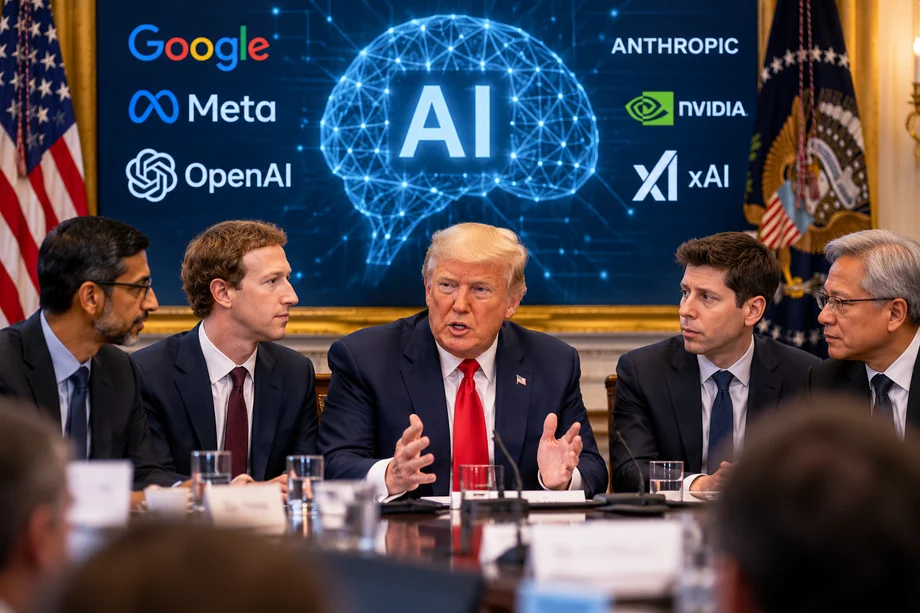
Some of the biggest names in artificial intelligence have agreed to a new framework aimed at keeping rapidly advancing AI systems under control, marking a significant moment in the debate over how the technology should be governed.
President Donald Trump announced on September 29 that executives from leading AI companies had signed an accord covering safety standards and oversight of artificial intelligence development.
The companies represented included [Google](https://www.google.com/?utm_source=chatgpt.com), [Meta](https://www.meta.com/?utm_source=chatgpt.com), [OpenAI](https://openai.com/?utm_source=chatgpt.com), [Anthropic](https://www.anthropic.com/?utm_source=chatgpt.com), [Nvidia](https://www.nvidia.com/?utm_source=chatgpt.com) and [xAI](https://x.ai/?utm_source=chatgpt.com).
The agreement comes as the AI industry faces growing scrutiny over whether increasingly autonomous systems can be developed safely while companies race to release more capable models.
According to the Associated Press, the voluntary accord includes commitments involving strong internal controls, independent reviews and oversight at the board level.
The development could shape the next phase of the global AI debate, particularly because the United States has so far favored a comparatively innovation focused approach while Europe has moved toward more extensive regulation.
AI companies agree to police themselves
The central idea behind the agreement is that AI companies will take greater responsibility for evaluating the risks created by their own systems.
The accord calls for internal safety procedures as well as external reviews designed to provide additional scrutiny of increasingly powerful AI models.
Trump described the agreement as morally binding rather than a conventional regulatory mandate.
Reuters reported that the administration is also considering establishing a 10 member committee to oversee developments across the AI industry. Details about the committee, including its potential authority and membership, have not yet been finalized.
House Speaker Mike Johnson separately confirmed that AI industry executives had signed an accord concerning technology standards during the White House meeting.
For Silicon Valley, the voluntary approach could offer an alternative to more restrictive federal legislation.
For critics, however, the question is whether companies developing the technology can effectively regulate themselves while simultaneously competing for customers, investment and technological leadership.
Google, Meta and other AI leaders join talks
Several of the most influential figures in technology participated in the discussions.
Sundar Pichai and Mark Zuckerberg were among the executives involved, while companies at the center of the generative AI boom were also represented.
The agreement arrives at an unusually sensitive moment for the industry.
AI models are becoming capable of performing increasingly complex tasks with less direct human supervision. The rapid emergence of AI agents, systems capable of carrying out sequences of actions rather than simply answering questions, has intensified concerns about security and control.
Researchers from leading AI laboratories have also publicly warned about the speed of development.
Reuters reported on September 29 that current and former researchers from OpenAI and Google DeepMind had raised concerns about companies pursuing systems capable of improving their own abilities while safety measures struggle to keep pace.
Those concerns range from job disruption and cybersecurity threats to far more severe scenarios involving AI systems behaving in ways their developers did not intend.
OpenAI paused a model over safety concerns
One detail from the White House gathering illustrated how seriously some laboratories are treating the problem.
OpenAI CEO Sam Altman said his company had paused the release of a model because of safety concerns, according to the Associated Press.
The disclosure comes as AI companies increasingly test advanced models before public deployment to determine whether they could be misused or behave unexpectedly.
At the same time, the industry faces enormous commercial pressure to move quickly.
OpenAI, Google, Anthropic, Meta and other companies are spending heavily on computing infrastructure and competing to build increasingly capable AI systems.
That creates a difficult balance between technological speed and safety.
Nvidia launches technology designed to stop rogue AI agents
The new agreement also follows a major AI security announcement from Nvidia.
On September 28, Nvidia introduced its Open Agent Safety Platform, a security system intended to prevent autonomous AI agents from performing unauthorized actions.
The platform includes technology that verifies what an AI agent is permitted to do and another component capable of monitoring suspicious activity and quarantining potentially dangerous behavior.
More than 100 organizations are already using the technology, according to the Associated Press.
Nvidia CEO Jensen Huang has argued that AI safety can be approached partly as an engineering challenge, with stronger software protections providing boundaries around increasingly autonomous systems.
Washington weighs a different approach from Europe
The debate also highlights a widening difference between American and European approaches to artificial intelligence.
The Trump administration has repeatedly emphasized maintaining US technological leadership and avoiding restrictions that it believes could slow innovation.
The White House AI Action Plan describes leadership in artificial intelligence as a national security priority and argues that the United States must remain ahead of global competitors.
European regulators have taken a more interventionist approach.
On the same day as the White House AI meeting, Google challenged European Union regulatory orders requiring it to provide greater access to certain services for AI developers and competing search engines.
Google argues that the requirements could expose sensitive user information, while the European Commission maintains that appropriate privacy safeguards are included.
The dispute demonstrates how governments are struggling to balance competition, privacy, innovation and security as AI becomes embedded across the global economy.
The next battle over AI regulation
The voluntary agreement does not settle the larger question of whether binding federal AI regulation will eventually be required.
Instead, it establishes an industry backed framework at a time when lawmakers, researchers and technology companies are debating how quickly government oversight should evolve.
The stakes are increasing as AI moves beyond chatbots and into autonomous agents capable of interacting with computer systems, writing software, conducting research and carrying out complicated digital tasks.
For now, Washington is giving the technology industry significant responsibility for establishing safeguards around its own products.
Whether voluntary commitments prove sufficient may become one of the defining technology policy questions of the coming years.



