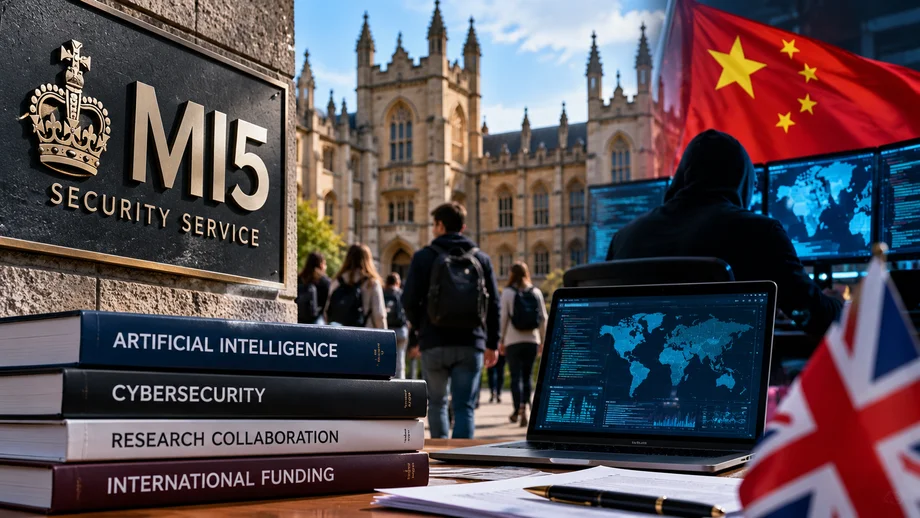
Britain’s MI5 has issued an extraordinary espionage alert to universities and researchers, warning them to review ties with a Chinese research organisation accused of helping strengthen China’s technical spying capabilities.
The Security Service said on September 30 that the China General Technology Research Institute, known as CGTRI, has “very strong ties” to China’s Ministry of State Security, the country’s civilian intelligence and security service.
According to MI5, more than 100 academics linked to the United Kingdom have contributed to research projects funded by Chinese intelligence through CGTRI.
The research covered sensitive areas including artificial intelligence, cybersecurity and technologies that could potentially be used for espionage.
MI5 stressed that some academics may not have known who was ultimately funding the projects.
What is MI5 warning universities about?
MI5 says CGTRI funds academic research in China on technologies that can enhance intelligence gathering capabilities.
The agency alleges that the organisation’s primary purpose is to finance research that directly improves the technical capabilities of China’s Ministry of State Security.
The warning represents an unusually public intervention by Britain’s domestic intelligence service.
Universities have been advised to immediately review existing or planned collaborations involving CGTRI.
Researchers working with Chinese institutions have also been urged to establish where funding ultimately originates before participating in projects.
Security Minister Dan Jarvis told university leaders to end arrangements involving the organisation, according to the Associated Press.
The warning does not accuse every researcher who worked on the projects of knowingly assisting Chinese intelligence.
MI5 specifically acknowledged that institutions and academics may have participated in good faith without understanding the alleged links between CGTRI and Chinese intelligence.
AI and cybersecurity research targeted
The technologies involved make the case particularly significant.
MI5 identified artificial intelligence and cybersecurity among the research areas connected with projects funded through CGTRI.
Other areas reportedly included covert communications systems and steganography.
Steganography involves concealing information inside another message, file or object so that the existence of the hidden information is difficult to detect.
Such technology can have legitimate academic and commercial applications, but it can also be valuable for intelligence operations.
MI5 says research funded through CGTRI has supported the espionage activities of China’s Ministry of State Security and therefore poses a threat to UK national security.
More than 100 UK linked academics involved
One of the most striking elements of the MI5 alert is the scale of the academic connections.
The agency says more than 100 academics linked to Britain contributed to projects funded by the Chinese intelligence service through CGTRI.
The researchers were associated with multiple British institutions.
The Guardian reported that CGTRI has funded 100 or more academics across UK universities in exchange for access to research that British intelligence alleges was ultimately transferred to China’s intelligence apparatus.
However, MI5’s own statement makes an important distinction.
Some academics may not have known CGTRI was behind the Chinese research projects to which they were contributing.
That distinction means the alert is primarily intended to expose the alleged funding structure and prevent future cooperation rather than suggest that all researchers knowingly participated in espionage.
Universities told to review partnerships immediately
MI5 is asking universities to examine both current and planned research collaborations.
The agency says academics should identify the ultimate source of funding when working with Chinese institutions and ensure that CGTRI is not involved.
Researchers and institutions have also been told to familiarise themselves with Britain’s national security legislation.
MI5 advised any institution or individual considering continued participation in research ultimately funded through CGTRI to obtain independent legal advice.
The warning could have significant consequences for universities because international partnerships are an important part of British academic research.
Universities frequently collaborate with foreign institutions on scientific and technological projects, making it increasingly important to determine who is financing research and how the results may ultimately be used.
Why AI research has become a security issue
Artificial intelligence is increasingly viewed not only as a commercial technology but also as a national security asset.
Advanced AI systems can potentially be applied to cybersecurity, intelligence analysis, surveillance, autonomous systems and military technology.
That has made university research particularly important.
Academic institutions frequently conduct early stage research that can later become valuable for governments, technology companies and defence organisations.
Britain has already been expanding its focus on AI security.
In June, the UK and Germany announced closer cooperation between their AI safety and security institutions, with both governments agreeing to work together on understanding and managing risks associated with advanced artificial intelligence.
The latest MI5 warning adds espionage and foreign research funding to those concerns.
China rejects espionage accusations
China has repeatedly rejected Western allegations that it uses academic, commercial and professional networks for espionage.
Reuters reported that Beijing has consistently denied similar spying accusations.
The Chinese embassy has previously described related Five Eyes allegations about Chinese intelligence activities as fabricated and defamatory.
The latest MI5 claims therefore remain allegations made by British intelligence.
CGTRI has been publicly identified by MI5 as having strong ties to China’s Ministry of State Security, but China disputes the broader accusations made by Western governments concerning its espionage activities.
That disagreement reflects a growing intelligence confrontation between China and several Western countries.
UK concerns about Chinese espionage are growing
The university alert is the latest in a series of British warnings about alleged Chinese intelligence operations.
UK security agencies have increasingly focused on attempts to obtain sensitive information through methods that extend beyond traditional espionage.
These can include cyber operations, professional recruitment, business relationships and academic cooperation.
The Washington Post described the September 30 announcement as the first alert of its kind independently issued by MI5, highlighting how unusually public the intelligence service has become about the alleged threat.
The alert also follows previous warnings issued by members of the Five Eyes intelligence partnership.
Britain, the United States, Australia, Canada and New Zealand cooperate extensively on intelligence and national security matters.
Earlier warnings have focused on alleged efforts to recruit individuals with access to sensitive government and corporate information.
Researchers may face legal risks
The MI5 alert carries implications beyond university policy.
Britain has strengthened legislation designed to counter foreign intelligence activity and state threats.
MI5 specifically told institutions and researchers to ensure they understand their responsibilities under national security law when considering future research partnerships involving CGTRI.
Britain also introduced additional powers through the National Security (State Threats) Act 2026, which received Royal Assent in July.
The legislation gives the government new powers to designate organisations involved in state threat activity and creates offences covering certain forms of support or assistance for designated bodies.
The immediate MI5 alert does not mean academics previously involved with CGTRI have committed crimes.
Instead, the agency is warning researchers that continuing certain relationships after the alleged intelligence links have been publicly disclosed could create legal and national security concerns.
Universities face a difficult balancing act
The case highlights a broader challenge facing universities across Britain and other Western countries.
Scientific progress increasingly depends on international cooperation.
Artificial intelligence, cybersecurity, quantum computing and advanced engineering are global research fields in which academics routinely collaborate across borders.
But many of the same technologies can have both civilian and intelligence applications.
Governments are therefore attempting to protect strategically important research without cutting universities off from legitimate international cooperation.
MI5’s latest warning suggests Britain believes greater scrutiny of research funding is now necessary.
For academics, the question may no longer simply be who they are collaborating with.
It may also be who ultimately pays for the research, who receives the results and how that technology could eventually be used.



