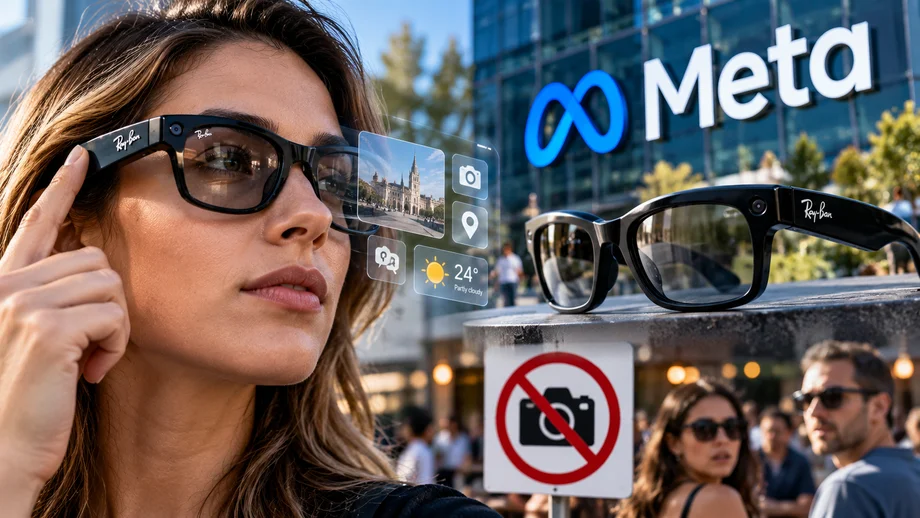
Meta is accelerating its push to make smart glasses a mainstream computing platform, betting that artificial intelligence and wearable devices could eventually change the way people interact with technology.
At its latest Connect conference, [Meta](https://www.meta.com/?utm_source=chatgpt.com) unveiled an expanded range of smart glasses and lightweight virtual reality hardware while extending the availability of its Ray Ban Display glasses to additional international markets.
The announcements arrive at a complicated moment for wearable technology. Meta's glasses have become one of the most successful products in the emerging smart glasses market, but their growing popularity has also intensified concerns about privacy, recording and whether people nearby can meaningfully consent to being captured.
Meta expands its smart glasses lineup
One of the most notable additions is Ray Ban Meta Audio, a new version that removes the camera entirely.
The glasses retain microphones, speakers and artificial intelligence capabilities, allowing users to interact with Meta's AI services through voice commands.
According to Reuters, the camera free model will start at $349 and is scheduled to begin shipping on October 13. Meta says removing the camera has also helped create a thinner design and extend battery life to as much as 12 hours.
The company's latest generation of traditional Ray Ban smart glasses will continue to include cameras, while new styles are being added to the range.
Meta is also expanding its Ray Ban Display glasses, which place digital information directly within the wearer's field of view.
The Guardian reports that the Display models are being introduced more widely in the United Kingdom, Canada and parts of Europe, with prices reaching approximately €899 depending on the market.
Meta wants AI on your face
The strategy reflects Meta's broader ambition to move computing beyond smartphones.
Instead of constantly taking a phone from a pocket, smart glasses could allow users to communicate with an AI assistant, listen to audio, capture photos, receive information and perform everyday digital tasks while continuing to look at the world around them.
Meta is integrating its Muse AI assistant across its wearable products. The company says users will increasingly be able to complete tasks such as shopping, making appointments and managing everyday activities through voice commands.
The long term ambition is much larger.
Technology companies increasingly see wearable AI devices as a possible successor, or at least a major complement, to the smartphone.
Meta is competing in a field that includes some of the world's largest technology companies, with the industry searching for the next major personal computing platform.
Privacy concerns are becoming harder to ignore
The same capabilities that make smart glasses attractive also create their biggest problem.
Unlike smartphones, glasses can remain positioned naturally on a person's face while recording.
That can make it much more difficult for people nearby to immediately recognize that a camera is present.
Concerns have intensified as videos recorded through smart glasses have appeared online showing people who apparently did not know they were being filmed.
The Los Angeles Times reported that the backlash has spread to businesses, courtrooms and entertainment venues, while privacy organizations have raised concerns about how increasingly sophisticated wearable cameras could affect civil liberties.
The issue has become particularly visible in London.
Some bars, theaters and other venues have restricted smart glasses because of concerns surrounding covert filming and consent.
The debate presents Meta with a difficult challenge.
For wearable AI to become an everyday technology, people who are not wearing the devices may need to trust them just as much as the people who buy them.
Meta says its glasses signal when they record
Meta's camera equipped AI glasses include a capture LED designed to notify people nearby when photos or videos are being recorded.
According to Meta, the white light flashes during photo capture and remains active while video is being recorded.
The company says the camera is automatically disabled when the system detects that the LED has been blocked or tampered with.
Meta has continued strengthening that protection after users discovered ways to cover the recording indicator after a video had already started.
A software update was introduced to stop the camera from continuing to record when the LED becomes obstructed during an active recording.
The company argues that these protections demonstrate its effort to build privacy safeguards directly into the hardware.
Critics say the wider issue remains more complicated than whether a recording light is visible.
Removing the camera does not eliminate every concern
Meta's decision to introduce camera free glasses appears to address one of the most obvious criticisms surrounding wearable devices.
But the new model still contains microphones.
IDC research director Jitesh Ubrani told Reuters that removing cameras addresses some privacy concerns but does not eliminate questions about audio recording and consent.
That distinction could become increasingly important as AI assistants become capable of processing more information from their surroundings.
Smart glasses work best when they understand context.
But the more information a device can collect about the environment, conversations and people around its wearer, the more complicated the privacy questions become.
Meta recently introduced an additional privacy control allowing smart glasses users to prevent certain visual data from being stored and used for AI training, according to Business Insider.
The company has also said ordinary photos and videos captured for a user's personal gallery are stored privately on the glasses until the wearer chooses to import them to a phone.
Meta is also shrinking virtual reality hardware
Smart glasses were not Meta's only major wearable announcement.
The company also revealed a dramatically lighter virtual reality device designed to provide capabilities traditionally associated with bulkier headsets.
The new Meta VR Glasses weigh approximately 100 grams because major components, including the processor and battery, have been moved into a separate pocket sized unit.
The glasses use high resolution displays and support eye tracking, hand gestures, entertainment, productivity applications and other immersive experiences.
The device is expected to launch in spring 2027 for approximately $1,300.
Reducing weight could address one of the biggest barriers that has prevented virtual reality headsets from becoming everyday devices.
Whether consumers will accept the price remains another question.
The battle to replace the smartphone is taking shape
Meta's expanding investment in AI glasses suggests the company believes wearable computing has moved beyond the experimental stage.
Smart glasses are becoming lighter, more capable and increasingly connected to artificial intelligence.
At the same time, their success could depend on solving a problem that cannot be addressed through technical specifications alone.
Trust.
Consumers may enjoy taking hands free photos, listening to music and communicating with AI without looking at a phone.
People standing beside them may have very different concerns.
That tension between convenience and privacy could ultimately determine whether AI glasses become the next major personal computing platform or remain a technology that society never fully becomes comfortable wearing everywhere.



