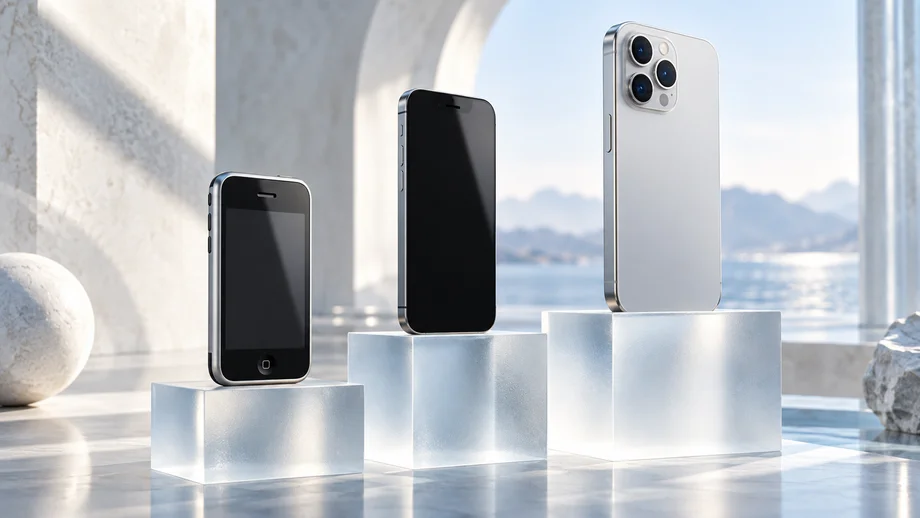
When Apple introduced the first iPhone in January 2007, its most consequential feature was not a specification. It was the way people interacted with it. A large touchscreen replaced most physical buttons, allowing the same surface to become a keyboard, a music player or a web browser.
The [original iPhone announcement](https://www.apple.com/ie/newsroom/2007/01/09Apple-Reinvents-the-Phone-with-iPhone/) described a handset with a 3.5-inch display, a two-megapixel rear camera and either 4GB or 8GB of storage. It reached American customers in June 2007. Its mobile data connection used EDGE, and the first version had neither the App Store nor the sophisticated camera system later associated with the brand.
The iPhone 3G in 2008 addressed connectivity with faster cellular networking and added GPS. Just as significantly, the [App Store opened that July](https://www.apple.com/hk/en/newsroom/2008/07/14iPhone-App-Store-Downloads-Top-10-Million-in-First-Weekend/). Independent developers could now distribute applications through a central marketplace. The iPhone’s usefulness no longer depended only on what Apple included at purchase.
The 3GS followed in 2009 with a stronger emphasis on speed and video recording. The pattern established during these early years became familiar: some generations changed the physical design, while others improved the experience inside an existing shape. A phone’s progress was increasingly measured by how quickly it opened applications, processed images and connected to services.
The [iPhone 4 in 2010](https://www.apple.com/ie/newsroom/2010/06/07Apple-Presents-iPhone-4/) made the display a central selling point. Its 960-by-640-pixel Retina screen retained the 3.5-inch size while making text and photographs substantially sharper. An Apple A4 chip, a five-megapixel rear camera, 720p video recording and a front camera for FaceTime expanded its capabilities.
The iPhone 4S brought Siri and an eight-megapixel camera in 2011. In 2012, the iPhone 5 moved to a taller four-inch display, LTE connectivity and the Lightning connector. These changes reflected growing demand for faster browsing, more space for content and a thinner device. Apple’s [model identification archive](https://support.apple.com/en-us/108044) documents how the family’s dimensions and designs changed across these generations.
In 2013, the [iPhone 5s introduced the A7 chip and Touch ID](https://www.apple.com/bg/newsroom/2013/09/10Apple-Announces-iPhone-5s-The-Most-Forward-Thinking-Smartphone-in-the-World/). Its 64-bit architecture marked an important computing transition, although the practical benefits depended on applications and software evolving with it. Fingerprint authentication made unlocking the phone easier and helped establish biometric security as an everyday habit. The colourful iPhone 5c offered a different design alongside it.
Screen size changed more dramatically with the [iPhone 6 and 6 Plus in 2014](https://www.apple.com/lv/newsroom/2014/09/09Apple-Announces-iPhone-6-iPhone-6-Plus-The-Biggest-Advancements-in-iPhone-History/). Their 4.7-inch and 5.5-inch displays gave video, maps and reading more room. The larger format also showed that a smartphone could replace tasks once reserved for a tablet or laptop, even if typing and extended work remained more comfortable on a computer.
The [iPhone 6s generation](https://www.apple.com/ae/newsroom/2015/09/09Apple-Introduces-iPhone-6s-iPhone-6s-Plus/) in 2015 added a 12-megapixel rear camera, 4K video and Live Photos. The iPhone SE in 2016 paired a smaller, familiar design with newer internal hardware. Later SE models continued the idea that a less expensive iPhone could reuse an established exterior while receiving a more capable processor.
The [iPhone 7 and 7 Plus](https://www.apple.com/newsroom/2016/09/apple-introduces-iphone-7-iphone-7-plus/) brought water resistance in 2016, while the Plus model combined wide-angle and telephoto rear cameras. Portrait mode, delivered through a subsequent software update, used depth information to simulate background blur. Removing the headphone socket also exposed a recurring trade-off in smartphone design: a new direction could create inconvenience for people using existing accessories.
The iPhone 8 and 8 Plus continued the home-button design in 2017, but the [iPhone X](https://www.apple.com/newsroom/2017/09/the-future-is-here-iphone-x/) established a new direction. A 5.8-inch OLED display covered much more of the front, Face ID replaced Touch ID, and gestures took over the home button’s role. OLED allowed deeper blacks because individual pixels could switch off. The A11 Bionic’s neural engine also showed how specialised processing was becoming important alongside conventional CPU speed.
The XS, XS Max and XR broadened that approach in 2018. Then the [iPhone 11 Pro in 2019](https://www.apple.com/newsroom/2019/09/iphone-11-pro-and-iphone-11-pro-max-the-most-powerful-and-advanced-smartphones/) introduced a three-camera arrangement combining ultra-wide, wide and telephoto views. Night mode illustrated the growing importance of computational photography: the final image could be assembled from several exposures rather than a single moment captured by the sensor.
The [iPhone 12 generation in 2020](https://www.apple.com/newsroom/2020/10/apple-introduces-iphone-12-pro-and-iphone-12-pro-max-with-5g/) added 5G, MagSafe accessories and a flatter exterior. OLED displays spread across the main lineup. Faster networking expanded what was possible away from Wi-Fi, although the improvement a customer experienced depended on local coverage and network capacity.
In 2021, the [iPhone 13 Pro models gained ProMotion](https://www.apple.com/newsroom/2021/09/apple-unveils-iphone-13-pro-and-iphone-13-pro-max-more-pro-than-ever-before/), with adaptive refresh rates reaching 120Hz. More frequent screen updates made scrolling and supported animations look smoother. That was a different kind of progress from increasing resolution: it improved how motion appeared rather than simply adding more pixels.
The [iPhone 14 Pro in 2022](https://www.apple.com/ie/newsroom/2022/09/apple-debuts-iphone-14-pro-and-iphone-14-pro-max/) introduced a 48-megapixel main camera, an always-on display and Dynamic Island. The higher sensor resolution offered additional photographic flexibility, but megapixels alone did not determine quality. Lens performance, sensor size, exposure, stabilisation and image processing remained essential.
The [iPhone 15 Pro generation in 2023](https://www.apple.com/newsroom/2023/09/apple-unveils-iphone-15-pro-and-iphone-15-pro-max/) moved to USB-C and introduced the A17 Pro chip and titanium construction. The Pro Max received a five-times telephoto camera. USB-C made the connector more familiar across phones, laptops and accessories, although data-transfer capabilities still differed between models.
The [iPhone 16 in 2024](https://www.apple.com/ie/newsroom/2024/09/apple-introduces-iphone-16-iphone-16-plus/) added the A18 chip and Camera Control, while Apple increasingly linked its hardware strategy to Apple Intelligence. In 2025, the [standard iPhone 17](https://www.apple.com/id/newsroom/2025/09/apple-introduces-iphone-17/) brought ProMotion beyond the Pro range. Features that once distinguished the most expensive models were gradually reaching a wider audience.
By September 2026, the [iPhone 18 Pro and 18 Pro Max](https://www.apple.com/newsroom/2026/09/apple-debuts-iphone-18-pro-and-iphone-18-pro-max/) combined the A20 Pro chip with an updated vapour-chamber cooling system. Apple presented sustained performance as a major benefit. Cooling matters because a processor cannot indefinitely maintain demanding workloads if heat forces it to slow down. Manufacturer performance claims, however, should not be confused with independent testing across every application.
Apple’s [iPhone 18 Pro specifications](https://support.apple.com/en-la/148590) list a 6.3-inch OLED display with adaptive refresh rates up to 120Hz and 48-megapixel main, ultra-wide and telephoto cameras. The main camera’s variable aperture gives additional control over incoming light. Its four-times telephoto lens should also be distinguished from the eight-times “optical-quality” option, which uses sensor cropping rather than a separate eight-times optical lens.
Across this history, the largest performance gains have come from several systems working together: processors, graphics hardware, memory, storage, image processing and software. A single clock-speed figure cannot meaningfully explain the distance between the first iPhone and the iPhone 18 Pro.
The transformation is clearest in ordinary tasks. A device once used for basic photographs and relatively slow mobile browsing became capable of demanding games, advanced video capture and complex image editing. Yet progress has never removed every compromise. Battery ageing, repair costs, storage needs and software support still shape how useful an iPhone remains long after its launch.



