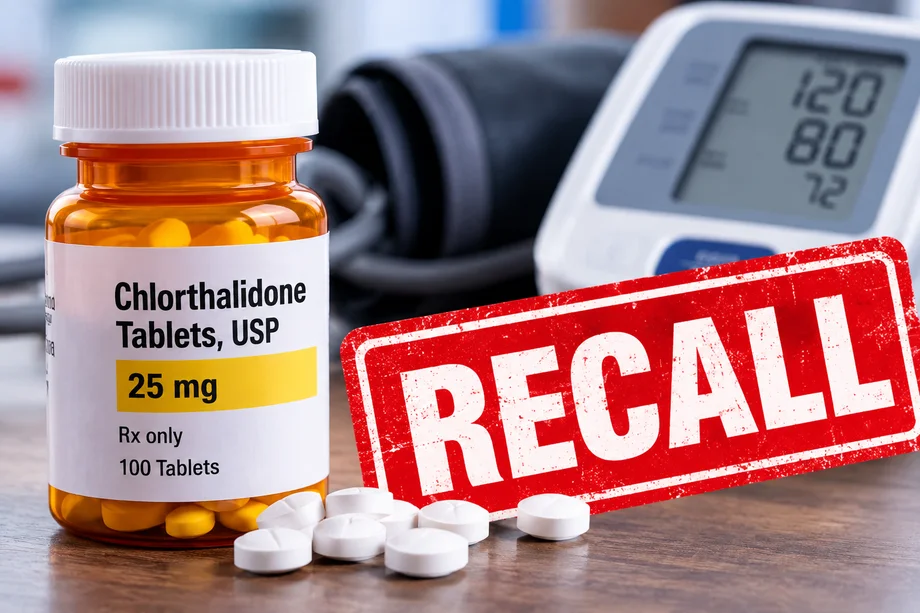
More than 25,000 bottles of a widely used blood pressure medication are now affected by two nationwide recalls in the United States, raising new questions for patients who take chlorthalidone to control hypertension.
The recalls involve chlorthalidone tablets, USP, 25 mg, manufactured by Inventia Healthcare Limited and distributed in the United States by Rising Pharma Holdings.
The latest recall covers 13,567 bottles and was initiated on September 3, 2026. The U.S. Food and Drug Administration later classified the action as a Class II recall after the medication failed dissolution specifications.
That action follows an earlier recall involving approximately 11,460 bottles of chlorthalidone from the same manufacturer. Together, the two recalls involve more than 25,000 bottles distributed nationwide.
Why is chlorthalidone being recalled?
The central issue involves how the tablets dissolve.
Dissolution testing is used to determine whether a medication breaks down and releases its active ingredient as intended. If a tablet does not dissolve according to required specifications, the amount or rate at which the medication becomes available to the body may be affected.
That is particularly important for a medication designed to control blood pressure.
The June recall notice showed that testing found a mean dissolution result of 78 percent, below the specified acceptance criterion. Testing also found the chlorthalidone assay slightly below its approved specification.
The September recall similarly resulted from failed dissolution specifications and remains ongoing.
Which chlorthalidone bottles are affected?
Patients taking chlorthalidone should not assume that every version of the medication is recalled. The actions concern specific products and batches.
The latest recall involves chlorthalidone tablets, USP, 25 mg, packaged in bottles containing 100 tablets.
The identifying information is:
NDC: 64980 599 01
Batch: RISA24002
Expiration: April 2027
Quantity recalled: 13,567 bottles
The earlier recall involved batches RISA24001 and RISB24002, also with an expiration date of April 2027. Those products were packaged in 100 tablet and 1,000 tablet bottles.
Patients whose pharmacy transferred their tablets into a standard prescription container may not see the original manufacturer batch number. In that situation, a pharmacist can help determine whether the prescription came from an affected lot.
What does an FDA Class II recall mean?
The Class II designation is important, but it does not mean that serious harm is expected for everyone taking the medication.
Under the FDA classification system, Class II applies when exposure to a recalled product may cause temporary or medically reversible adverse health consequences, or when the probability of serious adverse health consequences is considered remote.
The September recall was initiated on September 3 and subsequently classified as Class II by the FDA.
The earlier chlorthalidone recall received the same classification.
What is chlorthalidone?
Chlorthalidone is a prescription diuretic frequently used to treat high blood pressure.
Often described as a water pill, the medication helps the kidneys remove excess sodium and water from the body. This can reduce blood volume and help lower blood pressure.
It can also be prescribed for fluid retention associated with certain medical conditions.
Because the medication is used to manage conditions that may carry significant cardiovascular risks, patients should be cautious about changing treatment without professional medical advice.
Patients should not suddenly stop taking the medication
The recall does not mean patients should automatically stop taking chlorthalidone.
People who discover that their prescription may come from one of the affected batches should contact their pharmacist or prescribing health professional for instructions.
The FDA advises that stopping a recalled medicine can sometimes create a greater health risk than continuing to take it temporarily. Patients should therefore discuss the situation with a doctor or pharmacist before changing or discontinuing treatment.
A pharmacist may also be able to determine whether a prescription came from an affected batch and arrange an appropriate replacement when necessary.
Second chlorthalidone recall in just a few months
The latest action is particularly notable because it is the second major chlorthalidone recall involving Inventia Healthcare in only a few months.
The earlier recall began on June 5 and affected 11,460 bottles. The latest action began September 3 and added another 13,567 bottles.
Both involved 25 mg chlorthalidone tablets and quality concerns related to dissolution.
With the two actions combined, more than 25,000 bottles are affected.
For millions of Americans managing high blood pressure with prescription medication, the key message is straightforward: patients taking chlorthalidone should check their prescription information, contact their pharmacy if they cannot identify the manufacturer or batch, and seek professional medical guidance before making any change to their treatment.



