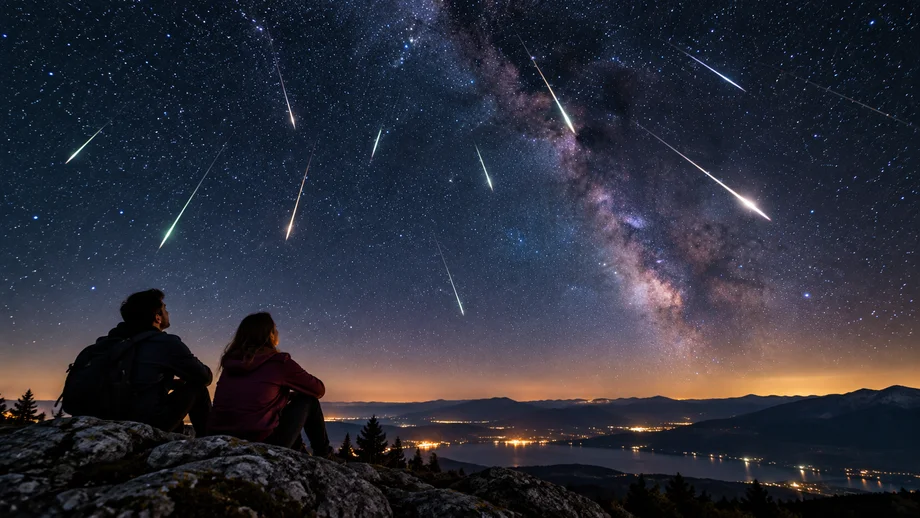
The night sky will offer a special spectacle during October 2026, when the rain of the Orionide meteors reaches the peak of activity and will give millions the opportunity to see bright traces of Earth's atmosphere.
According to NASA, the phenomenon will be more active during the night of October 21st and the first hours of October 22nd. Orionoids are one of the most popular meteor rains and can be observed by both hemispheres on the planet.
What makes this phenomenon especially interesting is its origin. Meteres are produced by small particles of dust and debris that the famous Halley comet has left behind during its journey around the sun.
Every year, the Earth passes through this area of space. When particles enter the atmosphere at extraordinary speeds, they burn and create bright lines that humans know as falling stars.
NASA explains that the Orionide meteors can travel some 26 miles [66 km] per second, sometimes creating visible tracks for a few moments.
In ideal conditions, far from artificial lighting and under a clear sky, observers can see between 10 and 20 meteors an hour.
However, the year 2026 presents a barrier - the light of the moon.
According to the astronomical guide published by NASA for October, the moon will be in its rising stage and its lighting may make meteors more pale to recognize.
For this reason, the US agency recommends surveillance during the last hours of the night, especially after the moon has set.
In many places, the most favorable period is expected to be about three o'clock in the morning and until before dawn, although the exact time changes according to location.
Meteres seem to come from the direction of the Orion Star, but they can appear in any part of the sky. This means that there is no need to keep looking at a single point.
Experts recommend choosing a place away from city lights, avoiding the telephone screen, and giving your eyes time to adapt to darkness.
No telescopes or professional equipment is needed to see the phenomenon. In fact, the naked eye is often the best way because it enables a broader view of the sky.
Orionoids are active from October 2nd to November 7th, but nights near the peak offer the best opportunity to see a greater number of meteors.
Fenomen can be observed in North America, Europe, Asia, and other parts of the world if the weather conditions are favorable.
For those who want to experience a natural spectacle without traveling far away, the nights of October 21 and 22 may be among the most interesting astronomical moments of this month.



