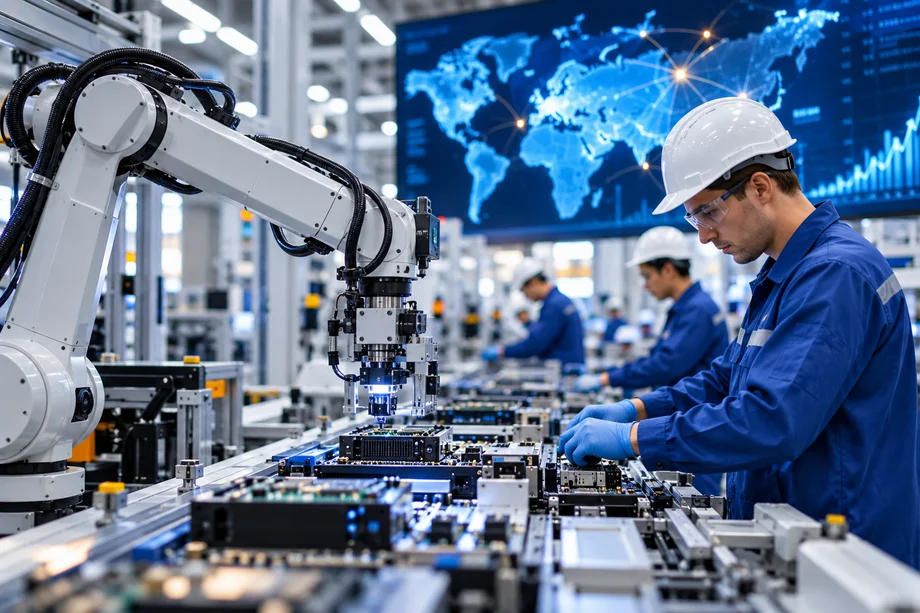
The global artificial intelligence boom is spreading beyond technology companies, with factories across Europe and Asia benefiting from growing demand for AI infrastructure.
Manufacturing activity in the eurozone accelerated in September to its strongest level since May 2022, while several major Asian economies also recorded stronger factory activity, Reuters reports.
Europe sees stronger factory growth
The S&P Global Eurozone Manufacturing Purchasing Managers' Index rose to 52.9 in September from 52.7 in August. A reading above 50 signals expansion.
New orders increased at their fastest pace since early 2022, while exports recorded their strongest growth in more than four years.
Germany, Europe's largest industrial economy, continued its manufacturing recovery, while the Netherlands recorded particularly strong activity. France, Italy and Spain also reported expansion.
One important driver is growing investment in machinery and equipment linked to artificial intelligence, data centers and other technology infrastructure.
Asia benefits from AI demand
A similar trend is appearing across Asia.
Reuters reports that strong demand for semiconductors and AI related products supported manufacturing in several major exporting economies.
Taiwan's manufacturing PMI climbed to 56.7, while South Korea benefited from strong export demand.
China also returned to manufacturing growth. Official data showed its PMI rising to 50.1 in September from 49.8 in August. India also reported stronger manufacturing activity.
Japan was an exception, with factory growth slowing as weaker domestic production offset stronger exports.
Billions are flowing into AI infrastructure
The scale of AI investment is creating opportunities well beyond chipmakers.
Data centers require servers, electrical equipment, cooling systems, construction materials and enormous amounts of electricity.
Reuters reported this week that Japan's largest power generator, JERA, is involved in plans for a $15 billion hyperscale data center near Tokyo.
In France, supercomputer manufacturer Bull has doubled production capacity at its Angers factory as Europe increases investment in domestic computing infrastructure, Reuters reports.
AI is becoming a wider economic force
The latest figures suggest that the AI investment boom is increasingly influencing traditional industries.
Machinery producers, electrical equipment manufacturers, construction companies and energy providers are benefiting alongside semiconductor and technology businesses.
Risks remain, particularly from high energy prices and borrowing costs. But September's manufacturing data suggests that billions being invested in artificial intelligence are already having a measurable impact on factories across Europe and Asia.



