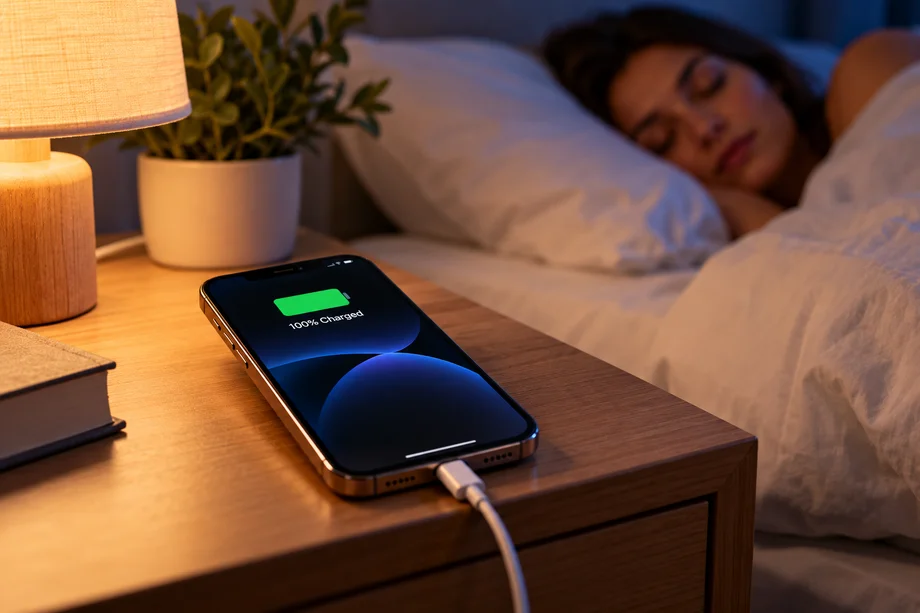
Plugging your phone into a charger before going to bed has become an almost automatic nightly routine.
You wake up with 100% battery and a phone ready for another day.
But one question continues to worry smartphone users: does leaving a phone charging overnight slowly destroy its battery?
The short answer is more complicated than a simple yes or no.
Modern smartphones are designed to stop continuously charging once the battery reaches its target level. However, keeping a lithium ion battery at a very high charge for long periods, particularly when combined with heat, can contribute to battery aging.
Your phone does not simply keep charging forever
Modern iPhones and Android phones contain charging management systems that control how power reaches the battery.
Apple, for example, uses Optimized Battery Charging on compatible iPhones. The feature learns a user's charging routine and can delay charging beyond 80% until closer to when the phone is expected to be unplugged.
Many Android manufacturers offer similar battery protection features.
Samsung allows users to enable battery protection options designed to reduce the amount of time the battery remains fully charged.
So leaving a modern smartphone connected overnight does not mean electricity is being forced endlessly into an already full battery.
The bigger enemy is heat
If you want your phone battery to remain healthy for several years, temperature matters.
Lithium ion batteries degrade faster when exposed to excessive heat.
Apple specifically warns that using or charging an iPhone in very hot conditions can permanently shorten battery life.
That makes some charging habits more problematic than simply leaving the phone plugged in.
Charging a phone underneath a pillow or blanket can trap heat around the device. Wireless charging may also generate more heat than some wired charging situations.
If your phone becomes unusually hot while charging, removing the case or moving it to a cooler, ventilated surface may help.
Should you stop charging at 80%?
You may have heard another increasingly popular recommendation: never charge your phone beyond 80%.
There is some logic behind it.
Lithium ion batteries experience greater stress when maintained at extremely high or extremely low states of charge for prolonged periods. Keeping the battery away from those extremes can help reduce long term degradation.
This is why manufacturers increasingly provide charging limits.
Recent iPhones allow users to select a charge limit, while Samsung and other Android manufacturers provide comparable battery protection settings.
But that does not mean everyone must live with only 80% battery.
If you need maximum battery life during the day, charging to 100% remains a normal use case. Battery protection features are primarily useful for people who want to preserve battery capacity over several years.
Is fast charging damaging your battery?
Fast charging itself is not automatically bad.
Phones and chargers communicate to regulate how much power is delivered, and charging speed generally slows as the battery approaches full capacity.
Again, heat is the important factor.
A phone that repeatedly becomes extremely hot while fast charging may experience faster battery degradation than one that remains at a moderate temperature.
Using reputable chargers and cables that meet the manufacturer's specifications is therefore important.
What about charging from 0% to 100%?
You do not need to completely drain a modern smartphone before charging it.
That advice comes largely from older battery technologies.
Lithium ion batteries work well with partial charging. Plugging your phone in at 30%, 40% or 50% is perfectly normal.
Regularly allowing the battery to fall completely flat provides no special benefit.
So, can you charge your phone overnight?
Yes, modern smartphones are designed to handle overnight charging.
But if you want to maximize battery health over several years, there are a few sensible habits worth adopting.
Enable optimized charging or battery protection, avoid excessive heat, use reliable charging equipment and consider an 80% charge limit if you rarely need the full capacity.
Your battery will eventually degrade regardless of how carefully you charge it. That is simply how lithium ion batteries work.
But treating heat and prolonged high charge levels sensibly may help your phone's battery stay useful for considerably longer.



