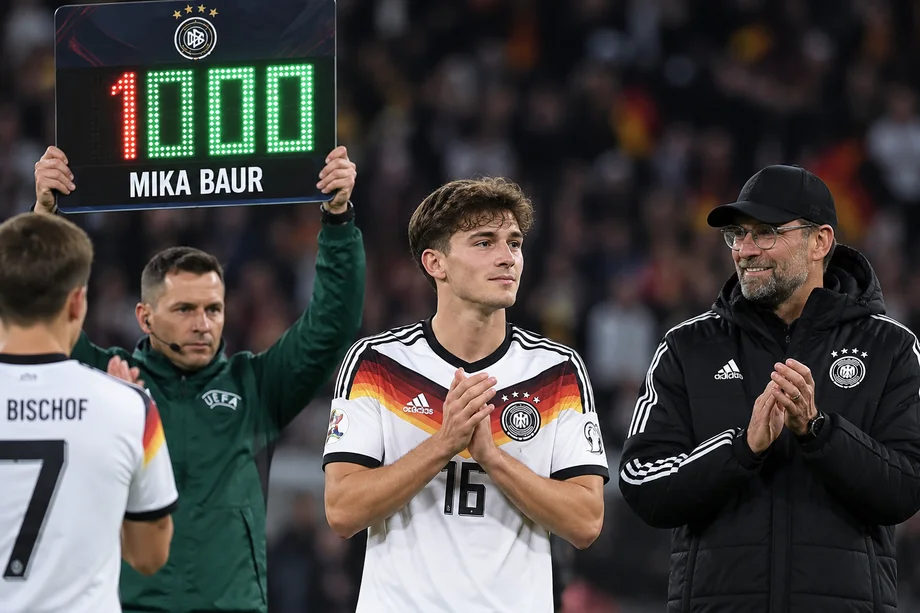
Mika Baur has written his name into German football history.
The 22 year old midfielder became the 1,000th player to represent Germany's senior men's national team when he made his international debut during Thursday night's 2:0 UEFA Nations League victory over Serbia in Munich.
Germany coach Jürgen Klopp introduced Baur during the closing stages of the match, replacing goalscorer Tom Bischof.
It was already a memorable night for Germany, with Bischof and Florian Wirtz scoring in a convincing victory that gave Klopp his first win since taking charge of the national team.
For Baur, however, the evening carried an additional historical significance.
Germany reaches the magic number 1,000
Germany's international football history stretches back to 1908.
More than a century later, Baur became player number 1,000 to wear the national team's shirt at senior level.
Shortly before his introduction, Said El Mala had entered the match and became Germany international number 999. Baur followed him from the bench to claim the landmark number.
After the match, Baur described the experience as "surreal."
He said the entire evening had been special for the team and admitted that he had been surprised when Klopp told him he was going into the game.
Who is Mika Baur?
Baur was born on July 9, 2004 and currently plays for Celtic in Scotland.
His rise has been remarkably quick.
After developing in the SC Freiburg system, Baur moved to SC Paderborn in 2024. His performances there eventually earned him a transfer to Celtic, where he continued his development before receiving his first senior Germany call up.
Before joining Celtic, Baur had established himself as a regular at Paderborn, recording four goals and six assists. His move to Glasgow was reported to be worth around €8 million including potential bonuses.
A Germany debut followed only months later.
His father is a German sporting legend
The Baur name was already famous in German sport long before Mika's football breakthrough.
His father, Markus Baur, is one of Germany's best known former handball internationals.
Markus represented Germany 228 times and scored 712 goals, winning the European Championship in 2004 and the World Championship in 2007.
Mika also played handball as a child before eventually choosing football.
His father was not in Munich to witness the historic debut in person. The family instead planned to attend Germany's following Nations League match against Greece in Thessaloniki.
Klopp is transforming Germany's squad
Baur's debut also highlights the scale of change taking place under Jürgen Klopp.
Germany entered the Serbia match searching for its first victory under the new coach after a 1:1 draw with the Netherlands and a 1:0 defeat against Greece.
Klopp responded by selecting an entirely different starting eleven against Serbia.
Goalkeeper Jonas Urbig and winger Derry Scherhant made their senior debuts from the start. Said El Mala, Baur and Vitaly Janelt later joined them in making their first Germany appearances.
Bischof opened the scoring in the 39th minute before Wirtz added Germany's second shortly after the hour mark.
The 2:0 victory finally gave Klopp his first win as Germany manager.
A night Baur will never forget
Only days before the Serbia match, Baur admitted that playing for Germany had seemed far away before receiving the call.
He said he wanted to absorb the experience, enjoy his opportunity and leave his own mark on the national team.
He has now done exactly that.
Whatever happens during the rest of Mika Baur's international career, his name will remain permanently attached to one remarkable statistic.
More than 118 years after Germany played its first official international match, Baur became the country's 1,000th senior men's international footballer.
For a 22 year old making his first appearance, it was a debut that immediately earned him a permanent place in German football history.